Label Text
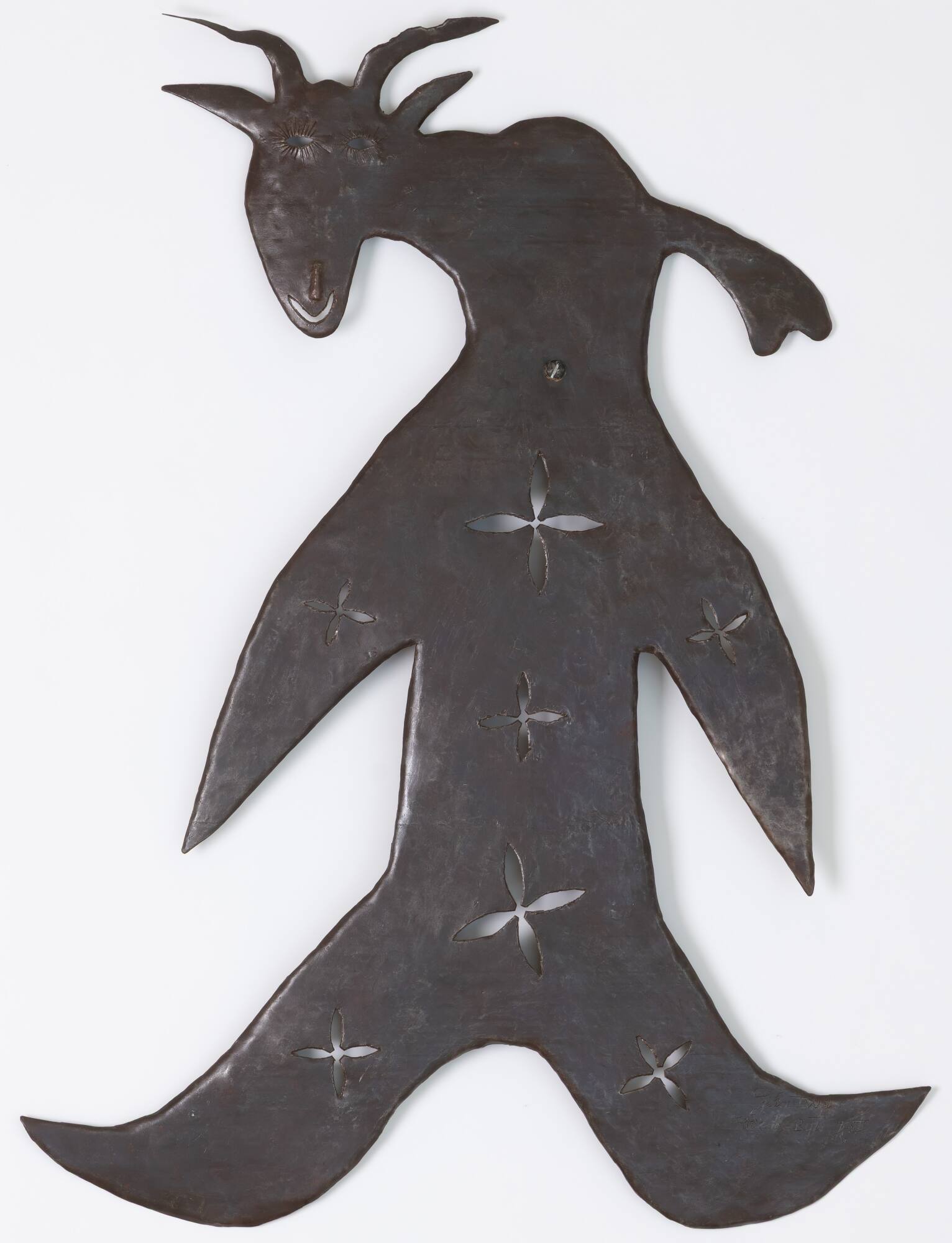
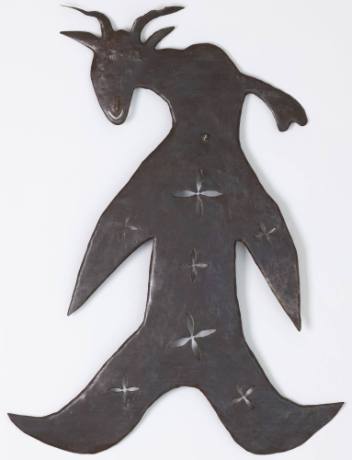
Renowned for their genius in transforming discarded materials into dramatic works of art, Haitian artists discovered that cast off oil drums could be recycled into unique metal cut-outs, known as fé koupé (cut metal). Steel drums became ubiquitous in Haiti after being left behind by American forces involved with the occupation of Haiti between 1915 and 1934. Georges Liautaud was likely the first artist to work with the material. He trained as a blacksmith for the Haitian American Sugar Company to maintain the railroad tracks and soon became highly sought-after for the elaborate cemetery crosses he forged in his spare time. Liautaud began producing metalwork for the international Haitian art market after encountering De Witt Peters, an American painter (1902-1966) who helped found Le Centre d'Art in Port-au-Prince. Liautaud’s Metamorphose depicts a human figure whose head is merged with the body of a goat. This figure likely represents a manifestation of the soul known in Haitian Vodou as a met tet, or “master of the head.” In a special ceremony, a spiritual guardian, called a loa, may be revealed to an individual. The loa can be represented by a particular animal, like the goat depicted here. This piece functions as a symbolic representation of the close relationship between humans and loa.
Exhibition History
Published References
Exhibition History
Published References
DimensionsOverall: 34 x 26 in. (86.4 x 66 cm)
Accession Number 2025.37
Classificationsmetal
SignedG. Liautaud (inscribed l,r)
Inscriptionsaix-des-Bgts Haiti (inscribed l,r)
ProvenanceArtist. John Brady, Jr., Des Moines, IA [purchased, ca. 1967]; Mr. and Mrs. William Peverill, Des Moines, IA [purchased from the previous, ca. 1985]; John Peverill, Des Moines, IA [acquired from the previous by descent]; Des Moines Art Center [purchased from the previous, 2025]