Go
Visit
Plan Your Visit
Pappajohn Sculpture Park
Accessibility
Tours
Shop
Event Calendar
Art
Exhibitions
Collections
Learn
Classes
Community Access
Education and Resources
Ongoing Programs
Scholarships
Find A Class
Support
Become a Member
Give
Volunteer
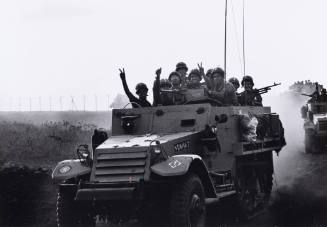
Israel Strikes into Lebanon: wounded Lebanese soldier and Israeli soldier peacefully exchange cigarettes, February 1972, 1972
Vintage gelatin silver print
Des Moines Art Center Permanent Collections; The Jeff Perry Photography Collection given in honor of Myron and Jacqueline Blank, 2025.274
Not On View
Image Not Available
for Israel Strikes into Lebanon: wounded Lebanese soldier and Israeli soldier peacefully exchange cigarettes, February 1972
Share
Expand
Favorite
View PDF
Home
Art
Collections
Home
Collections
Explore
Artists & Creators
Favorites
Skip to main content
Dimensions
Overall: 6 1/2 x 9 3/4 in. (16.5 x 24.8 cm)
Accession Number
2025.274
Classifications
photograph
Provenance
Jeff Perry; Des Moines Art Center [gift from the previous, 2025]
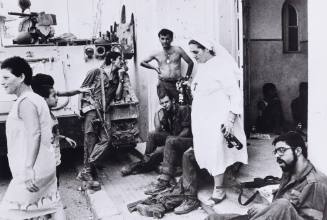
Israel Strikes into Lebanon: wounded Lebanese soldier and Israeli soldier peacefully exchange cigarettes, February 1972
Previous
Next
Image Not Available
for Israel Strikes into Lebanon: wounded Lebanese soldier and Israeli soldier peacefully exchange cigarettes, February 1972
Explore More From This Collection
Image Not Available
for Sharon offers resignation: Defense Minister Ariel Sharon of Israel resigned as a consequence of his indirect role in the killing of Palestinian refugees in the Beirut camps of Sabra and Shatila by Lebanese Christian phalanges between September 16th to 18th, 1982 as the result of a four months investigation. The 54 year old Defense Minister was the principal architect of Israel’s invasion of Lebanon last year, and had been battling for his political survival since the outcome of the enquiry’s report. The last official function of Ariel Sharon on the day the commission report was published, attending in Tel Aviv a meeting of the “Jabotinsky Order” (a portrait on the wall of Zeev Jabotinsky Zionist Revisionist Movement and Menahem Begin’s spiritual leader), February 8, 1983
Sharon offers resignation: Defense Minister Ariel Sharon of Israel resigned as a consequence of his indirect role in the killing of Palestinian refugees in the Beirut camps of Sabra and Shatila by Lebanese Christian phalanges between September 16th to 18th, 1982 as the result of a four months investigation. The 54 year old Defense Minister was the principal architect of Israel’s invasion of Lebanon last year, and had been battling for his political survival since the outcome of the enquiry’s report. The last official function of Ariel Sharon on the day the commission report was published, attending in Tel Aviv a meeting of the “Jabotinsky Order” (a portrait on the wall of Zeev Jabotinsky Zionist Revisionist Movement and Menahem Begin’s spiritual leader), February 8, 1983
1983
Image Not Available
for The evacuation of the Sinai by the Israelis, prior to the handing over of the territory to the Egyptians, was met with fierce resistance by the Israeli settlers. The army removed protestors before the settlements and army camps could be dismantled. The region was being returned in accordance with the Israel/Egypt peace agreements. Soldier clearing settlement with foosball table in foreground
The evacuation of the Sinai by the Israelis, prior to the handing over of the territory to the Egyptians, was met with fierce resistance by the Israeli settlers. The army removed protestors before the settlements and army camps could be dismantled. The region was being returned in accordance with the Israel/Egypt peace agreements. Soldier clearing settlement with foosball table in foreground
1982
Image Not Available
for Israeli troops advance into Beirut: Israeli forces moved past the Green Line into the Museum crossing and continued heavy bombardment of West Beirut, yet they opened up a single crossing between the two sectors of the capital to allow thousands of residents to flee out of the West. This line separates the Muslim West and Christian East of Beirut. Lebanon’s internal security forces said at least 250 persons had been killed and nearly 700 wounded in this recent attack. Israeli and Palestinian forces consolidated their positions around the front line near the airport and the Green Line, and at the Museum and the Galerie Samaan crossings. Palestinian refugees arriving in a camp in Sidon, July 1982
Israeli troops advance into Beirut: Israeli forces moved past the Green Line into the Museum crossing and continued heavy bombardment of West Beirut, yet they opened up a single crossing between the two sectors of the capital to allow thousands of residents to flee out of the West. This line separates the Muslim West and Christian East of Beirut. Lebanon’s internal security forces said at least 250 persons had been killed and nearly 700 wounded in this recent attack. Israeli and Palestinian forces consolidated their positions around the front line near the airport and the Green Line, and at the Museum and the Galerie Samaan crossings. Palestinian refugees arriving in a camp in Sidon, July 1982
1982
Image Not Available
for Israeli-Occupied Lebanon: a father is united with his son in a warm embrace where both are fighting against Palestinian guerrillas here in Israel’s drive to Beirut, June 12, 1982
Israeli-Occupied Lebanon: a father is united with his son in a warm embrace where both are fighting against Palestinian guerrillas here in Israel’s drive to Beirut, June 12, 1982
1982
Image Not Available
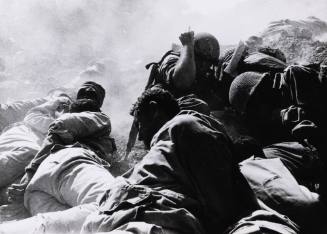
for Yom Kippur War: the Israeli army made a rapid advance towards the Suez Canal and took hundreds of Egyptian soldiers as prisoners of war. Afterwards, they were loaded in trucks and taken to a special camp, Fayed, Egypt, October 24, 1973
Yom Kippur War: the Israeli army made a rapid advance towards the Suez Canal and took hundreds of Egyptian soldiers as prisoners of war. Afterwards, they were loaded in trucks and taken to a special camp, Fayed, Egypt, October 24, 1973
1973
South Korea: An American first aid map treats a wounded United States soldier at front line aid station. The wounded are evacuated by litters carried on jeeps to hospitals in the rear, July 10, 1950
1950
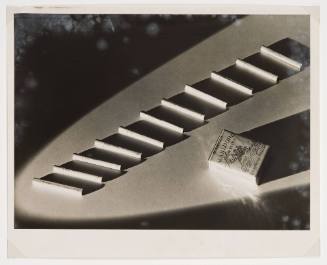
Marlboro Cigarettes on table
Paul J. Woolf
ca. 1932
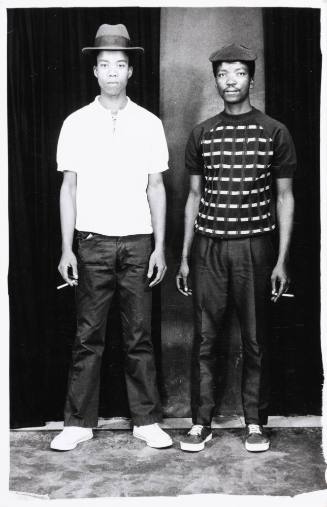
Untitled (two men with cigarettes), April 7, 1973
Z.J.S. Ndimande & Son
printed c. 1973
Image Not Available
for The evacuation of the Sinai by the Israelis, prior to the handing over of the territory to the Egyptians, was met with fierce resistance by the Israeli settlers. The army removed protestors before the settlements and army camps could be dismantled. The region was being returned in accordance with the Israel/Egypt peace agreements. Abandoned military outpost, Sinai
The evacuation of the Sinai by the Israelis, prior to the handing over of the territory to the Egyptians, was met with fierce resistance by the Israeli settlers. The army removed protestors before the settlements and army camps could be dismantled. The region was being returned in accordance with the Israel/Egypt peace agreements. Abandoned military outpost, Sinai
1982
A young German soldier lies dead beside his bicycle in the desert west of Gazala, Western Desert
George Rodger
1941
Sgt. Ralph Kilpatrick - Soldier Behind North Korea Lines for 77 Days: Taejon, South Korea: An army mess sergeant was the hero of the 24th Division when he returned from 77 death-despairing days behind communist lines. Ralph Kilpatrick, of Phoebus, Virginia, came out of the once-held enemy hills to his buddies in the 19th Infantry Regiment in good health with a harrowing story of grimly hanging to life in enemy-saturated territory. Kilpatrick is pictured as he received a medical checkup from Lieutenant Alfred J. Grose, of Rochester, New York, October 4, 1950
1950
New York Stock Exchange from Old Exchange Building, New York
Todd Webb
1959